
Craniosacral Therapy
Find it, fix it and then leave it alone. Andrew T. Still - Osteopath (1828-1917)
What is craniosacral therapy?
Briefly explained in German by the Cranio professional association: (click on the logo)

Craniosacral therapy goes back to the work of William G. Sutherland. He described this approach as a form of mindful perception with the hands – present, attentive, and in relationship with the whole person.
The term craniosacral refers to the cranium (the skull) and the sacrum (the sacral bone).
Sessions take place in comfortable everyday clothing and involve gentle, non-invasive touch. The focus is not on diagnosing or treating, but on consciously perceiving and exploring individual bodily and perceptual processes – at one’s own pace and with personal responsibility.

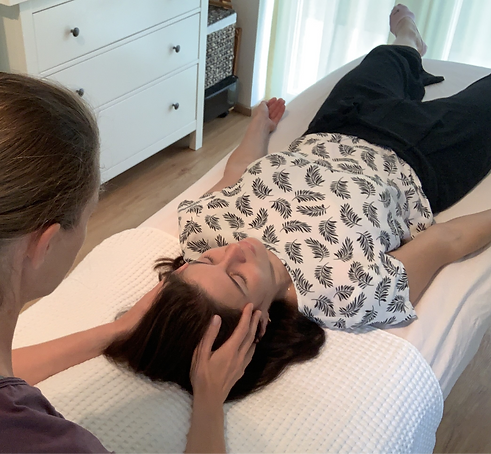
My approach in relation to the eyes
The eyes are anatomically part of the brain. This connection is taken into account by gently including the area of the head, the meninges, and the region around the eyes in the perception-oriented work.
The accompaniment is guided by the core principles of Complementary Therapy: holism, resource orientation, process openness and self-regulation.
Note
This offer is a body- and perception-oriented accompaniment within the framework of Complementary Therapy.
It does not replace medical or psychotherapeutic treatment, nor professional medical assessment.
I'm Member of Cranio Suisse